
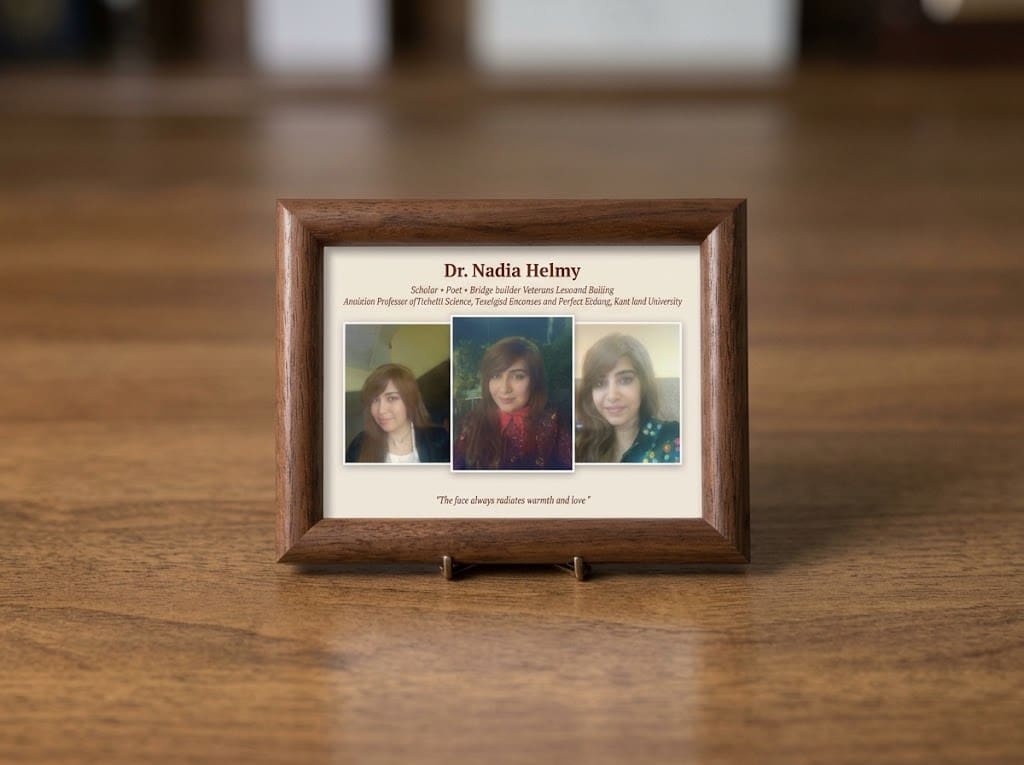

China is no longer a distant player in the Middle East. It buys the region’s oil, builds its ports and increasingly mediates in its conflicts. Yet in the Arab world, and certainly in Europe, surprisingly few people truly understand how Beijing thinks. Dr. Nadia Helmy is one of the exceptions, and in my opinion her voice deserves a wider audience.
A scholar who went to the source
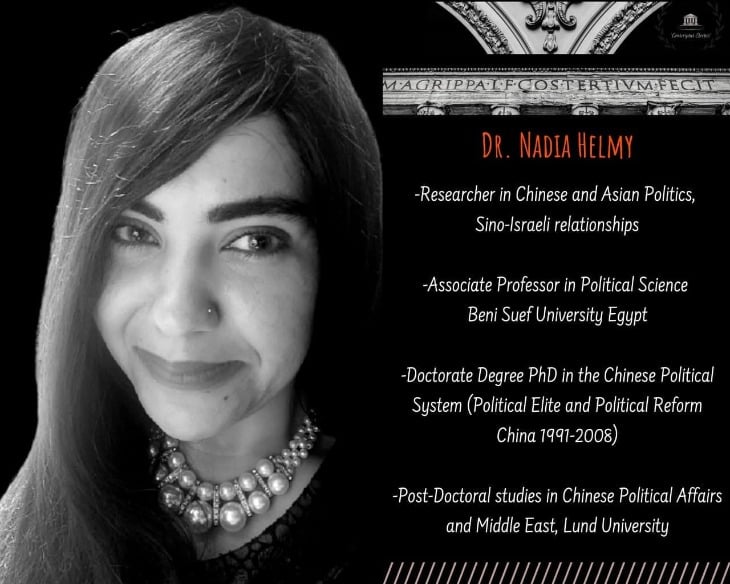
Helmy did not study China from a distance. After a degree in political science at Cairo University, she learned Chinese at Peking University and wrote her doctorate on the Chinese political system, focusing on elite politics and reform between 1991 and 2008. She worked as a Middle East specialist at Peking University’s research centre and later carried out postdoctoral research at the Centre for Middle Eastern Studies at Lund University in Sweden.
Today she is Associate Professor of Political Science at Beni Suef University in Egypt, where she heads a unit for South and East Asian studies. She also lectures regularly on Chinese affairs in Cairo.
Asking questions others overlook
What makes her work stand out is her choice of subjects. She writes about China’s relations with Israel, about how Beijing viewed the Arab uprisings, and about Islam in China and its ties with the Arab world. These are topics where Arab, Chinese and Western perspectives meet, and often clash. Few researchers are at home in all three.
She is also remarkably productive. Almost every week she publishes analyses on platforms such as Modern Diplomacy, on everything from Egypt’s place in China’s strategy to Beijing’s role in the war in Ukraine. Chinese media regularly ask her to explain the Arab view on China.
Scholar, poet and proud woman
Helmy is just as outspoken about who she is. In a recent post on LinkedIn she encouraged all women to embrace their femininity: “What I want to say and encourage all women to do is that I adore my femininity.” For her, that means feminine clothes and shoes, “high or low heels, it does not matter, the important thing is that it looks feminine.”
In a field that is still dominated by men, that self-confidence is a message in itself. Being a serious scholar of geopolitics and being proudly feminine are not opposites. Helmy shows that you can be both.
What many readers of her analyses do not know, but what I have come to know as her friend, is that she is also a gifted poet. Where her political writing is sharp and factual, her poetry shows another side of her: personal, sensitive and full of feeling. A scholar’s mind combined with a poet’s heart is a rare combination, and perhaps it explains why she understands people and cultures so well. Anyone who meets her notices it straight away: her face always radiates warmth and love.
Agree or disagree, but listen
Not everyone will share her conclusions. Her analyses are often sympathetic to Beijing’s view of the world, and Western readers will sometimes frown. But that is exactly why she is worth reading. We learn little from voices that only confirm what we already think. Helmy offers a perspective from Cairo, informed by years in Beijing and Lund, and that perspective is missing from most European debates.
In a time when the world is splitting into blocs, people who can build bridges between cultures are rare. Dr. Nadia Helmy is such a bridge builder. Read her, discuss her ideas, and form your own opinion. That is what good scholarship is for.
In the interest of transparency: Nadia Helmy is a close friend of mine. That is precisely why I know how much passion and hard work lie behind her writing.
Antonius (Ton) Bakker
Leave a Reply