
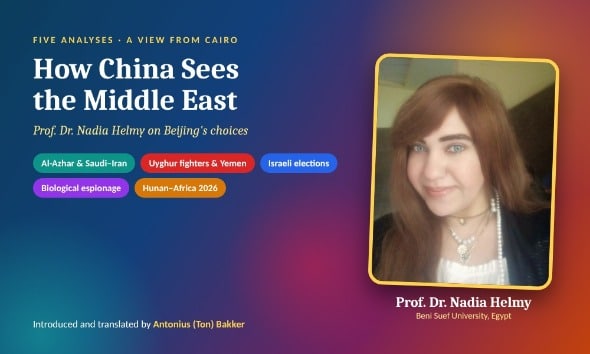

A Word of Introduction
By Antonius (Ton) Bakker
It is with great pleasure that I introduce Prof. Dr. Nadia Helmy to you. Nadia is an Egyptian political scientist at the Faculty of Politics and Economics of Beni Suef University in Egypt. She specialises in Chinese politics, the policy of the Communist Party of China and relations between China and the Middle East. Among other things, she studied at Peking University and did research at the Centre for Middle Eastern Studies of Lund University in Sweden.
Nadia is not only a valued fellow writer, but also a good friend of mine. For years we have shared thoughts on politics, culture and the world around us. I know her as a warm, sharp and committed person, who is also a gifted poet.
In this document you will read five of her recent analyses, originally published on the international platform Modern Diplomacy. They offer a rare view from Cairo of how China looks at the world. Not every reader will agree with all her conclusions, and that is not necessary. That is precisely why her analyses are worth reading: they give voice to a perspective that is rarely heard in the Western debate.
I wish you happy reading.
Antonius (Ton) Bakker
Introduction
I share with you – Dr. Nadia Helmy, Egyptian expert on Chinese political affairs, the policy of the ruling Communist Party of China and Asian affairs, intelligence analyst and Professor of Political Science at Beni Suef University – my latest international political analyses on Modern Diplomacy, an English-language website for global political analysis. These analyses have been discussed and translated into many languages around the world, are cited on international intelligence, military, defence and political websites, and top the list of the most widely shared analyses worldwide. The most important are:
1. Beijing’s vision of mechanisms to protect religious diversity from political exploitation and incitement between the Houthi and Iranian Shiite axis and the Saudi and Gulf Sunni axis, with mediation by Al-Azhar in Egypt. Chinese religious diplomacy: Al-Azhar’s mediation in the Iranian-Saudi dispute.
2. How Chinese intelligence benefits from Syria sending forces to Yemen to fight the Houthis, made up of Uyghur fighters whom Chinese intelligence and security services classify as terrorists.
3. China’s position on the upcoming Israeli elections and which outcome China prefers. The Israeli elections: who does China want to win, and what is at stake for Beijing?
4. The warning by China’s Ministry of State Security that foreign organisations are infiltrating ecologically sensitive areas in China under the guise of tourism or scientific research, and the dismantling by the Chinese authorities of a cross-border network trafficking in human and biological material. China warns of foreign espionage disguised as research, as authorities uncover a cross-border smuggling network.
5. China’s organisation of the Hunan-Africa 2026 conference in Egypt on mechanisms for settling trade disputes, to strengthen the investment climate and economic and strategic cooperation between China, Egypt, the African countries and the Global South.
Article 1 – Beijing’s Vision of Protecting Religious Diversity from Political Exploitation: Chinese Religious Diplomacy and Al-Azhar’s Mediation in the Iranian-Saudi Dispute
An analysis by Dr. Nadia Helmy, Egyptian expert on Chinese political affairs, the policy of the ruling Communist Party of China and Asian affairs, intelligence analyst and Professor of Political Science at Beni Suef University
Beijing’s vision of protecting religious diversity from political exploitation and incitement in the Middle East rests on the principle of “comprehensive security and development-oriented solutions”. China sees Al-Azhar’s religious initiative as a moral and intellectual contribution that complements its own historic diplomatic mediation between Riyadh and Tehran. Beijing approaches the regional rivalry between the Iranian-Houthi axis (Shiite) and the Saudi-Gulf axis (Sunni) from a strictly geopolitical perspective, and regards the exploitation of sectarian identities merely as a means of fuelling conflicts, not as their cause. China is therefore very wary of the use of religion and sectarianism as an instrument of “soft power” or “ideological subversion” by international powers (above all the West) to ignite sectarian tensions between the Sunni and Shiite axes in the Middle East. Beijing thus takes a pragmatic diplomatic view, aimed at managing regional stability and protecting the security of trade and energy routes through comprehensive development and security initiatives.
The comprehensive Chinese vision revolves around neutralising ideological and sectarian disputes and combating the political exploitation of religion. In this way China seeks to prevent the gains of peace in the Middle East from being undermined, particularly between the two axes of the sectarian conflict – the Houthi and Iranian Shiite axis and the Saudi and Gulf Sunni axis – and to intervene to sideline foreign or external parties that fuel this conflict. Whereas the West neutralises religion by separating it from the state and giving individuals freedom of organisation, China believes that neutralisation is only possible if the state fully embraces and guides religion through its national institutions and legitimate religious channels. Foremost among these is Al-Azhar, as a beacon of moderation and balance in the Middle East and the Arab and Islamic world. From this Chinese perspective, religion thus becomes an instrument for promoting stability and social harmony under the umbrella of the national identity and sovereignty of the legitimate state – and not a platform for opposition, political mobilisation, or stirring up identity-based, factional, denominational and sectarian conflict and incitement among members of one nation. China’s vision is aligned with Al-Azhar’s initiative through various mechanisms of protection and integration. Chinese political strategy thus complements the spiritual, religious and moderate role of Al-Azhar in Egypt in tackling the game of polarisation between the regional axes (the Houthi-Iranian axis and the Saudi-Gulf axis), through the following mechanisms:
One: mechanisms to neutralise the “political exploitation” of religion (the Chinese perspective)
The Chinese perspective on neutralising the “political exploitation” of religion rests on a fundamental and firm principle: subjecting the religious sphere entirely to the sovereignty of the state and its legitimate and religious institutions and channels, and cutting off any political or foreign branch that could fuel sectarian incitement, chaos and division between denominations and religions. Beijing believes that religion can be exploited by foreign powers (such as Western movements or transnational currents) as a means of political infiltration to undermine the national stability of states – especially against the background of the sectarian conflict between the Shiite Houthis and Sunni Saudi Arabia after the 2026 war with Iran. China has therefore replaced the Western model (based on the separation of church and state) with a model of “embracing and guiding religion” in the service of the goals and sovereignty of the nation state and to protect the wealth of states and peoples. This is done by:
1. Giving priority to the language of “common security” over ideology. Beijing believes that the Sunni-Shiite conflict is not inevitable, but is politically exploited to expand influence. China therefore relies on the Global Security Initiative (GSI), launched by Chinese President Xi Jinping. This initiative calls for diplomatic solutions that respect the sovereignty of states and empties inflammatory rhetoric of its substance by offering economic partnerships as an alternative.
2. The development model as an alternative to extremism (China’s Belt and Road Initiative). China takes the approach of “peaceful development”: tackling the roots of the economic crises in Yemen and the region pulls the rug out from under groups that use sectarian mobilisation for military and political ends.
Two: the role of Al-Azhar as a mediating Islamic authority
Al-Azhar in Egypt, as a beacon of moderate thought, is an essential pillar supported by the Chinese approach to regulating religious diversity and protecting it from incitement and sectarian and religious violence. This is done by:
1. Dismantling sectarian discourse. Al-Azhar strips religious legitimacy from attempts to frame political conflicts (such as the one between the Houthis and the Saudi-led coalition) in sectarian terms (Sunnis against Shiites).
2. Proposing comprehensive mediation initiatives. Al-Azhar’s religious initiatives, such as the call for Arab-Islamic mediation committees to prevent bloodshed and end wars, strengthen efforts towards political de-escalation. These meet with principled approval and response from various parties, including Yemeni and regional parties.
3. Anchoring a jurisprudence of “citizenship” instead of sectarianism. Al-Azhar advocates letting the concept of the nation state prevail over transnational sectarian loyalties. This fits seamlessly with the strict Chinese principle of “respect for sovereignty and non-interference in internal affairs”.
Three: tracks of integration between Beijing’s political mediation and Al-Azhar’s spiritual mediation
Integration between the tracks of China and Al-Azhar can be achieved by bringing the roles together: the Chinese role (political and developmental) and the role of Al-Azhar (spiritual and intellectual). This is done through:
1. Integration in building regional trust between the two axes of the sectarian conflict in the Middle East. Here China and Al-Azhar can play a role in the track of regional confidence-building. China can guide the agreement on restoring Saudi-Iranian relations to guarantee a stable political environment, while Al-Azhar builds intellectual bridges and promotes intra-Islamic dialogue to bring legal-theological positions closer together and prevent the declaring of others as unbelievers.
2. Integration in containing the crisis in Yemen between the Houthi axis and the Saudi-Gulf Sunni axis. In addition, China and Al-Azhar can play a role in the track of containing the Yemen crisis. China can exert diplomatic pressure to secure shipping routes and calm the fronts, so that trade and investment can continue to flow. This intersects with the role of Al-Azhar, which supports peace initiatives and provides legitimate and moral cover and committees for de-escalation and dialogue between the Shiite Houthis and the Gulf states.
3. Integration in training religious leaders. The track of training religious cadres connects Beijing’s political, developmental and economic role with Al-Azhar’s religious role. China’s political and developmental role consists of promoting mutual cooperation, fighting extremism through official channels and providing financial support and cover to religious affairs services. The role of Al-Azhar as a mediating Islamic authority focuses on training imams and spreading values of tolerance and diversity, so that the pulpit cannot be used for sectarian incitement between Sunnis and Shiites.
In short: Beijing’s vision of regional security, based on shared development interests, complements the moral and intellectual role of Al-Azhar. China provides the political framework and diplomatic guarantees between the capitals (Riyadh and Tehran), while Al-Azhar provides the intellectual and religious cover that defuses sectarian incitement and protects religious diversity from political exploitation in the conflicts between Sunnis and Shiites in the region.
Four: protection and integration between Chinese diplomacy and Al-Azhar’s mediation
The protective roles of pragmatic and practical Chinese diplomacy – with its solutions to the escalating problems and crises in the Middle East – and of Al-Azhar as a spiritual institution and religious authority restoring religious and sectarian stability in the Middle East and the Gulf complement each other. This fits with China’s political and developmental role, through:
1. Integration of moral and political influence. China is convinced that political agreements, such as the historic Beijing agreement on the reconciliation between Saudi Arabia and Iran, need cultural and religious protection in order to last and to isolate sectarian incitement. Beijing sees the initiative of the Grand Imam of Al-Azhar to establish an Arab-Islamic mediation committee as an extremely important legitimate mechanism that provides spiritual cover and prevents denominations from being politically exploited.
2. Dismantling sectarian polarisation. Beijing assumes that the conflict between the Sunni and Shiite axes is a conflict of regional interests dressed up in sectarian clothing. The Chinese vision supports the intellectual approach of Al-Azhar, which consistently emphasises “Islamic brotherhood and the prevention of bloodshed” and regards the legal-theological differences between Sunnis and Shiites as intellectual differences that justify neither conflict nor political incitement.
Five: the pillars of the Chinese vision for protecting regional stability
The Chinese mechanism, supported by the spirit of Al-Azhar’s initiative, rests on several dimensions, approaches and axes to defuse sectarian unrest and incitement in the Middle East:
1. China’s emphasis on separating religion and geopolitics. The Chinese mechanism stresses that a religious current must not translate into transnational political loyalty, as with the Houthis in Yemen, but that the sovereignty of nation states must be respected.
2. China’s emphasis on “development as an alternative to incitement”. China sees poverty, unemployment and marginalisation in conflict areas as the breeding ground for sectarian incitement. According to China, the solution lies in linking the Belt and Road Initiative to reconstruction and development projects that neutralise the language of weapons.
3. China’s call for multilateral dialogue, in coordination and cooperation with Al-Azhar’s spiritual mediation between the Sunni and Shiite axes. China calls for a shift from managing military crises to guiding sustainable dialogues, in which official diplomacy and intellectual mediation such as that of Al-Azhar come together to narrow the gap of trust between the Gulf and Iran.
Six: China’s position towards the “Houthi-Iranian axis” and the “Gulf-Saudi axis”
Beijing moves in an extremely sensitive middle position to maintain its network of relations and alliances with both the Sunni Saudi-Gulf axis and the Shiite Iranian axis in the Middle East, through:
1. Policy towards the Iranian and Houthi axis. China puts pressure on Tehran to calm the fronts of its allies (in particular the Houthis in Yemen) and calls on them to respond positively to Chinese peace initiatives and to prevent bloodshed. China believes that playing the sectarian card threatens international shipping routes and Chinese energy interests.
2. Policy towards the Saudi and Gulf axis. Beijing holds on to security and economic guarantees for its partnership with the Gulf and supports Saudi efforts to end the war in Yemen by political and diplomatic means, in order to protect the Saudi development vision (Vision 2030).
On the basis of this strategic analysis, Beijing regards Egypt, and Al-Azhar in particular, as a soft power and a moderate Islamic authority capable of breaking through the thick sectarian walls between Sunnis and Shiites in the Middle East and the Gulf. China believes that the combination of a “political agreement under Beijing’s auspices” and an “intellectual, spiritual and religious consensus and humanitarian mediation under Al-Azhar’s auspices” is the ideal formula for ending the political exploitation of religion and establishing lasting peace and strategic stability in the Middle East.
Article 2 – How Chinese Intelligence Benefits from Syria Sending Uyghur Fighters to Yemen to Fight the Houthis
An analysis by Dr. Nadia Helmy, Egyptian expert on Chinese political affairs, the policy of the ruling Communist Party of China and Asian affairs, Professor of Political Science at Beni Suef University
Political and media circles are circulating reports and discussions about a proposal by Syrian President Ahmed al-Sharaa to transfer Syrian and foreign fighters (including Chinese Uyghur fighters and members of the Turkistan Islamic Party) from Syria to Yemen to fight the Houthi movement. Although Syria has officially denied these reports, merely raising this scenario opens the door to an analysis of its security and military dimensions, and specifically of the question of how Chinese intelligence could benefit from such a presumed step. Security data and circulating intelligence reports indicate that Chinese intelligence views the file of the Uyghur fighters and the Turkistan Islamic Party in Syria, and its repercussions for China’s national security, with great concern. This is especially so since the fall of the former Syrian regime of Bashar al-Assad and the integration of a number of them into the military units of the new Syrian army, such as the 84th Division, with the full approval of the current Syrian President Ahmed al-Sharaa.
The analysis of Chinese intelligence, strategic, security and political circles regarding the Turkistan Islamic Party and its relationship with Yemen rests on the principle of protecting China’s national security and securing Beijing’s economic interests through indirect diplomatic and intelligence channels. China does not take part militarily in conflicts far from its borders, but manages this file through a complex network of balances. This is linked to the fact that Chinese intelligence – represented by the Ministry of State Security (MSS), which carries out the tasks of the Chinese intelligence service – regards the Turkistan Islamic Party (TIP) as a continuation of the East Turkestan Islamic Movement (ETIM). The latter is considered the greatest terrorist threat to China’s national security, particularly in the Muslim-majority region of Xinjiang. Chinese intelligence and security services therefore attach great importance to every movement of Uyghur fighters and members of the Turkistan Islamic Party. They fear that these fighters will be trained, armed and sent to carry out terrorist attacks in China, or to attack Chinese interests and investments in the Middle East and around the world. This leads think tanks and strategic analysis centres linked to the Ministry of State Security to dissect the political and security situation in Syria in case Uyghur fighters and members of the Turkistan Islamic Party are sent to Yemen to fight the Houthis, and to map the positive and negative consequences for China’s national security. In linking the Syrian and Yemeni fronts, Chinese calculations intertwine along the following intelligence dimensions and assessments:
One: the complex Chinese contradiction in the Yemen and Houthi file
China faces an extremely complex intelligence and political equation, in which its hostility towards the Turkistan party meets its relationship with the Yemen file:
1. Fear of the transfer of jihadist experience. Chinese security services fear that any contact with, or movement of, fighters to Yemen could lead to cross-border networks, or that Uyghur fighters will gain new experience in maritime guerrilla warfare and drones, in which the Houthis are skilled.
2. The suspicion of indirect Chinese support for the Houthis. Western and Yemeni intelligence reports, such as a report by Conflict Armament Research (CAR), state on the other hand that Chinese-made components and spare parts (dual-use or specifically for missiles) have reached the Houthis for the development of their ballistic missiles. Although Beijing officially and fully denies providing military support to the Houthis and stresses that it abides by UN Security Council resolutions, analysts believe that Beijing sometimes turns a blind eye to the activities of trading companies in order to secure its shipping routes in the Red Sea.
Two: Chinese intelligence links sending Uyghur fighters to Yemen with weakening the fighting power of the Turkistan Islamic Party
Beijing “tacitly” welcomes any scenario in which experienced Uyghur fighters are transferred from Syria to external fronts of attrition such as Yemen to fight the Houthis. From a Chinese intelligence perspective, deploying these fighters in heavy and distant battles contributes directly to breaking up the tight organisational structure they built in Syria’s Idlib province during their fight against ISIS, and wastes and fragments their manpower and accumulated combat experience. Chinese circles therefore associate their participation in the war in Yemen against the Houthis with the following advantages:
1. Direct human attrition. Beijing regards the Turkistan Islamic Party (made up of Uyghur fighters) as a direct threat to its national security. Transferring these fighters to a burning and complex front such as Yemen means they end up in a prolonged war of attrition against the Houthis, in which large numbers of them are eliminated or weakened outside China’s direct sphere of attention. At the same time, Chinese intelligence monitors the supply lines of the Turkistan Islamic Party and the movement of its fighters from Syria and Afghanistan to other fronts such as Yemen, for fear that they will gain advanced combat experience or access to advanced weapons, such as drones and the techniques used by the Houthis, which could in future be carried into the Chinese mainland.
2. Fragmentation of command and control. The departure of the fighters from their relatively stable environment in northern Syria (where some of them were previously absorbed into local structures) and their dispersal across external fronts weakens their organisational cohesion and dismantles their logistical networks.
3. Preventing them from thinking about a return to Xinjiang. China’s greatest concern is that these fighters would use their advanced military experience to plan operations in the Xinjiang region (East Turkestan), the Muslim-majority region in north-western China where they come from. Exhausting their fighting power in regional conflicts (such as in Yemen) reduces the chance that they can turn to threatening the Chinese mainland.
Three: expanding Chinese intelligence coverage and information gathering on Uyghur fighters across international borders in the event of a move to the Yemeni front
Security analyses and political research centres indicate that China pays close attention to monitoring and tracking cross-border fighters of the Turkistan Islamic Party (Uyghurs), as part of its counter-terrorism strategy and the protection of its growing foreign interests, especially in conflict zones such as Yemen. If members of the Turkistan Islamic Party move to the Yemeni front, Beijing relies on several mechanisms to expand its intelligence coverage there and gather information:
1. Tracking movements and communications. The movement of fighters across international borders (from Syria to Saudi Arabia or Yemen) offers Chinese intelligence a golden opportunity to monitor supply lines, trace financing networks and map the secret communication channels these groups use for their movements.
2. Updating watch lists. Military operations in Yemen produce new field data (dead, wounded, prisoners), which helps Beijing update its security databases on the Uyghur field commanders who have left the Xinjiang region.
3. Regional security and intelligence cooperation, through:
- Information exchange with local and regional powers: China relies on its balanced diplomatic and security relations with the influential parties in the Yemen file, such as Saudi Arabia, Iran and the internationally recognised Yemeni government, to obtain human and field intelligence on the movements of armed Uyghur and Turkistani groups.
- Activating diplomatic and security channels: joint meetings are used to exchange watch lists and biometric data, so that the Chinese authorities can identify these individuals at border crossings.
4. Technical and cyber intelligence (SIGINT):
- Digital surveillance: tracking digital footprints, social media accounts and encrypted communication channels that members of the organisation use for coordination or recruitment.
- Facial recognition and biometric data: China has highly advanced identification systems and compares the biometric data of fighters fleeing other fronts (such as Syria or Afghanistan) when they try to enter Yemen with forged passports.
5. Imagery and satellite intelligence (IMINT):
- Space surveillance: using China’s satellite network to monitor possible training camps, supply lines and remote areas in Yemen that these groups could use as safe havens.
- Tracking Uyghur and Turkistani terrorist elements with China’s integrated BeiDou satellite system: China uses BeiDou technology, developed by Chinese companies linked to the People’s Liberation Army and military research centres, instead of Western GPS technology for satellite navigation. This applies all the more since Iran has been fully equipped with the Chinese BeiDou satellite system, independent of Western and American tracking and observation systems.
6. Securing vital interests and combating piracy:
- The Chinese military base in Djibouti: China’s naval base in Djibouti (close to the Yemeni coast and the Bab el-Mandeb) enables Beijing to track maritime movements and smuggling through the Gulf of Aden and the Red Sea, which helps intercept attempts at maritime infiltration by fighters.
- Protecting the Belt and Road Initiative: the security of the waterways near Yemen is China’s highest priority. China therefore gathers more information to prevent threats against merchant ships or Chinese economic interests in the region, whether these come from Uyghur fighters and the Turkistan Islamic Party or from others.
Four: sending Uyghur fighters to Yemen and keeping their potential threat away from Chinese interests in the Middle East
Chinese intelligence – the Ministry of State Security and its Ninth Bureau, which deals with dismantling, internationally, terrorist networks that affect China’s national security – follows these developments in order to protect Belt and Road Initiative investments. China constantly fears that Uyghur fighters will attack its economic or diplomatic interests in the region. Pointing these fighters’ guns at the Houthis in the south of the Arabian Peninsula keeps their direct threat away from vital Chinese projects in the Levant and the nearby seaports. The following is an analysis of the Chinese intelligence and security approach to the file of the Uyghur fighters:
1. China’s strategy of “dismantling and elimination” rather than “relocating and steering” Uyghur fighters in Syria:
- Position towards the fighters: China categorically rejects any integration or resettlement of Uyghur fighters in any area whatsoever.
- Pressure in the Syrian arena: Beijing exerts conditional political and economic pressure on the new Syrian government under Ahmed al-Sharaa to definitively dismantle the military presence of the Turkistan party and to eliminate or extradite its members. China opposes their integration into the institutions of the new Syrian state or the Syrian Ministry of Defence, and opposes lifting sanctions on Syrian factions loyal to President al-Sharaa as long as this file has not been settled.
2. The nature of the Turkistani threat to Chinese interests:
- Direct hostility towards Beijing: leaders of the Turkistan Islamic Party have openly threatened, following developments on the ground in Syria, to move the fight to the Chinese mainland (the Xinjiang region) and to attack Chinese interests abroad.
- Extremist alliances: the Turkistan Islamic Party is historically linked to al-Qaeda, and organisations such as ISIS-Khorasan try to recruit its fighters for attacks on Chinese targets in Central Asia and the Middle East. If these fighters could move freely to Yemen, this would therefore also pose a double risk to the shipping routes and Chinese economic interests there.
3. Beijing’s mechanisms for protecting its interests in the Middle East:
- Electronic and intelligence cooperation: China deploys its technical capabilities to track down these fighters. Reports describe organised, Beijing-backed electronic campaigns that use artificial intelligence to monitor and infiltrate Uyghurs in conflict zones.
- Regional coordination: China seeks stricter border control and intelligence sharing with neighbouring countries, such as Tajikistan, Turkey and the Central Asian states, to prevent these fighters from infiltrating or fleeing from the battlefronts to other areas.
Five: Beijing strengthens its political and diplomatic leverage over the government of President Ahmed al-Sharaa to extradite Uyghur fighters to the Chinese authorities
Beijing uses a package of political and economic pressure in its negotiations with the government of Syrian President Ahmed al-Sharaa, with the aim of securing the extradition of Uyghur fighters and members of the Turkistan Islamic Party. The Syrian government, by contrast, prefers an approach of containment and internal arrangements rather than forced extradition, in an attempt to strike a diplomatic balance that preserves internal stability. The Chinese authorities therefore put pressure on their Syrian counterparts regarding the Uyghurs and the Turkistan Islamic Party on Syrian territory, through:
1. Pressure on the Syrian government. Beijing uses the Uyghur file as permanent leverage in its relationship with Damascus, and consistently demands that this file be settled or that wanted individuals be extradited, as a condition for contributions to reconstruction and investment. The departure of these fighters to another front could make it easier for China to track them separately, away from Syrian political complications.
2. Regional security coordination. This scenario increases the need of regional parties, such as Saudi Arabia or the Yemeni government, for intelligence cooperation with China in order to obtain information on the combat structure and military tactics of Uyghur fighters. This gives Beijing wider security influence in the Gulf and Yemen files.
On the basis of this strategic analysis, the core of China’s intelligence position becomes clear. China constantly seeks, with its diplomatic and intelligence instruments, to put pressure on the new Syrian leadership of President Ahmed al-Sharaa to dismantle and disarm the Turkistan Islamic Party or to expel its fighters. Beijing believes that exhausting these groups and weakening their military capacity in Middle Eastern conflicts (in Syria, or by keeping them busy on fronts such as Yemen) serves its national security in the long term – provided this does not lead to an expansion of their armed influence or to a threat to its vital economic interests in the region.
Article 3 – China’s Position on the Upcoming Israeli Elections: Who Does China Want to Win, and What Is at Stake for Beijing?
An analysis by Dr. Nadia Helmy, Egyptian expert on Chinese political affairs, the policy of the ruling Communist Party of China and Asian affairs, intelligence analyst and Professor of Political Science at Beni Suef University
Chinese think tanks and strategic and intelligence circles, such as the China Institute of Contemporary International Relations (CICIR) and the Chinese Academy of Social Sciences (CASS), regard the upcoming 26th Israeli elections as a crucial moment for reshaping the new geopolitical balances in the Middle East. They believe that the departure of Benjamin Netanyahu could serve Chinese interests in the medium and long term. According to political analyses and the positions of Chinese research centres dealing with the Middle East, China always applies the principle of “non-interference in the internal affairs of states” to the Israeli elections as its official and public policy, and expresses no public preference for any party or candidate. Nevertheless, Beijing views the outcome of these elections from a purely pragmatic, practical and flexible perspective, focused on its geopolitical and economic interests. The Chinese strategic reading of the upcoming Israeli elections, the possible replacement of the Netanyahu government and the implicit Chinese preferences can be summarised in the following main points:
One: the economic and technological perspective on Sino-Israeli relations and China’s wish for a stable environment for investment in Israel
1. Chinese investment in Israel. China attaches great importance to expanding its investments in Israeli infrastructure, such as ports and railways, and to its technological partnerships.
2. China prefers a new Israeli government that is less susceptible to American pressure on Beijing. Beijing implicitly leans towards any Israeli government that offers a stable environment for these investments and is less accommodating towards American pressure to restrict technological and economic cooperation between Israel and China.
Two: the regional political perspective and the Gaza war as a cause of tension between China and the current Israeli government
1. Relations between Beijing and Israel have been clearly strained since the events of October 2023 and the war in Gaza. China took a position supporting an immediate ceasefire and the establishment of a Palestinian state and criticised Israeli military policy, while the government of Benjamin Netanyahu accused Beijing of contributing to Israel’s international isolation.
2. Beijing prefers a stable Israeli government. Chinese analysts, think tanks and strategic, political and analytical circles believe that Beijing would prefer an Israeli government more focused on regional calm and de-escalation in the Middle East. Stability, after all, serves its largest economic project, “One Belt, One Road”, while a continuing regional conflict threatens its vital interests and the trade and energy routes in the region.
Three: China’s assessment of the “Netanyahu era”: from economic partnership to confrontation and accusations
1. The end of pragmatism. Chinese circles believe that Netanyahu – who for years pursued a policy of broad economic and technological openness towards Beijing – completely abandoned this course after the Gaza war and adopted an ideological position entirely on the side of the American axis, at China’s expense.
2. The crisis of direct accusations. Chinese intelligence reports note with displeasure Netanyahu’s direct accusations that Beijing is leading a “media blockade and anti-Israeli propaganda” through platforms such as TikTok. This has led Chinese think tanks to regard the current Netanyahu government as a “troublemaker” that harms China’s international image.
Four: the scenario of change and the rise of the opposition (the Bennett-Lapid alliance or Eisenkot)
1. Close strategic monitoring. Chinese intelligence and analysis services are closely following Israeli political alliances in the run-up to the elections, such as the Lapid-Bennett alliance or the rise of Gadi Eisenkot’s camp.
2. A more rational and diplomatic government. Chinese political circles believe that the fall of Netanyahu and the rise of a centre-left or moderate military government will change nothing about Israel’s organic alliance with Washington, but will bring “rationality and traditional diplomacy” back into Israeli foreign policy.
3. Reducing global polarisation. Beijing thinks that a new Israeli government will be less inclined to escalate the verbal and political battle with China and more flexible towards regional de-escalation arrangements. This gives Beijing more room to manoeuvre as a regional “peace mediator”, without clashing directly with Netanyahu’s intransigence.
Five: the calculations of China’s regional alliances (Iran and the “axis of resistance”)
1. Slowing down a wide regional war. The Chinese strategic analysis assumes that Netanyahu sees open wars as a means of political survival. His replacement could therefore reduce the chance of the region sliding into an all-out, direct war with Iran – China’s strategic oil and political ally through the 25-year strategic partnership agreement between Beijing and Tehran.
2. Protecting China’s Belt and Road project. Beijing believes that the continuing military escalation by the far-right Israeli government under Benjamin Netanyahu threatens China’s trade routes and vital supply chains in the Red Sea and the Eastern Mediterranean. For Beijing, Netanyahu’s departure therefore means the beginning of a regional calm that protects its investments and economic flows.
Six: Sino-American rivalry in the region and its relationship with the upcoming Israeli elections
1. Israel as an arena of a Cold War. Chinese think tanks realise that the United States is exerting strong pressure to purge Israeli infrastructure and technology of any Chinese influence, such as the Chinese presence in Israeli ports and the 5G networks of the Chinese company Huawei.
2. Exploiting Israel’s international isolation. According to the Chinese reading, Netanyahu’s harsh policy has deepened Israel’s international isolation and damaged Washington’s moral and political standing worldwide. Although Beijing prefers stable trade, Chinese analysts see in this American erosion an opportunity to strengthen China’s narrative in the “Global South” as a power that upholds international law and justice.
On the basis of this strategic analysis, we understand why Chinese strategic circles find the departure of Benjamin Netanyahu and his replacement by a more pragmatic, practical and flexible Israeli government desirable. It is not about wanting to pull Israel into the Chinese camp, but about lowering the regional tension that threatens Beijing’s economic interests in the Gulf and Iran, and about ending the personal and political hostility that Netanyahu adopted towards China at the end of his term.
Article 4 – China Warns of Foreign Espionage Disguised as Research, as Authorities Uncover a Cross-Border Smuggling Network
An analysis by Dr. Nadia Helmy, Egyptian expert on Chinese political affairs, the policy of the ruling Communist Party of China and Asian affairs, intelligence analyst and Professor of Political Science at Beni Suef University
In early October 2026, China’s Ministry of State Security (the intelligence service) warned of growing security and biological risks threatening national security. The ministry revealed that foreign organisations are infiltrating ecologically sensitive areas of the country under the guise of scientific research and tourism in order to steal genetic resources. The Chinese authorities also announced that a cross-border network for smuggling biological material and human genetic samples had been dismantled. The Ministry of State Security, which carries out the tasks of the intelligence service of the People’s Republic of China, then issued an official security warning on the risks of the illegal smuggling of genetic resources and biological material. The details of this warning and the Chinese security operation can be divided as follows:
One: infiltration under the cover of tourism and research
China’s Ministry of State Security reported via its official account that foreign organisations and bodies have abused apparently legitimate activities – such as academic exchanges, scientific research and tourist trips – to open illegal access routes into protected and sensitive environments in China. The aim of this infiltration is to collect China-specific genetic and ecological data without the required official approval of the State Council and the customs authorities. The main points of the Chinese security and intelligence warning were:
1. Warning of infiltration under various covers. Some foreign organisations try to enter ecologically sensitive areas in China under the guise of tourism or scientific research.
2. Theft of blood samples. Human blood samples are being collected illegally under the cover of medical examinations. The ministry pointed to the dismantling in 2025 of a cross-border network in Guangzhou that smuggled blood samples from pregnant women across 23 Chinese provinces.
3. Ecological and agricultural threat. The Chinese authorities warned against importing or exporting non-native animals, plants and seeds without an official permit, because of the risks to ecosystems, agriculture and public health.
4. Call for vigilance and reporting. The ministry called for permits and quarantine procedures to be requested in advance from the competent authorities and urged citizens to report suspicious cross-border movements of biological material.
Two: dismantling a network smuggling biological samples (blood of pregnant women)
As part of the fight against biological espionage, the Ministry of State Security presented the success of Guangzhou customs in breaking up a cross-border smuggling network whose illegal activities extended across 23 Chinese provinces. The details:
1. How the network operated. The network collected blood samples from pregnant women and illegally exported them abroad under the cover of “fake medical examinations”.
2. The possible aim. Chinese intelligence warned that the leaking of these samples and genetic data deprives China of its competitiveness in the field of genetic patents and poses a direct threat to national security and the integrity of the population’s human genome, with the risk that they are misused to develop biological weapons against the Chinese people.
Three: smuggling of non-native organisms and pets
The Chinese security and intelligence warning was not limited to human genes, but also focused on combating ecological risks resulting from:
1. Smuggling of seeds of rare plants and non-native animals, which foreign parties try to export in order to study them, or try to import illegally.
2. Official warning to travellers. The ministry called on citizens and travellers to be extremely careful during holiday periods about taking biological material, pets or medical samples across the border without prior permission.
Four: cover activities and methods used
According to the Chinese statement, foreign parties use soft-power activities and international cooperation as cover, including:
1. Academic exchanges and joint research: placing foreign researchers in local projects that give them access to biological samples.
2. Tourist and exploration trips: organising trips to rural areas or nature reserves with high biodiversity to discreetly collect field samples (soil, plants, water).
Five: the targets – genetic and ecological data
Following a growing series of foreign attempts to penetrate China with the aim of stealing human genes and other data, Beijing is focusing on protecting two main types of data:
1. Genetic data (DNA and genome). China fears that genetic data of the Chinese people will be used to develop ethnically targeted biological weapons, or that Western pharmaceutical companies will monopolise medical and therapeutic patents based on Chinese genes.
2. Ecological and geographical data. These include terrain surveys, water sources and rare species, which can be used for intelligence purposes or to harm food and environmental security.
Six: the legal and legislative context in China
This Chinese warning is not merely a media statement, but rests on a strict legal arsenal that China has built up in recent years:
1. The Biosecurity Law (in force since 2021): strictly regulates the collection, storage and export of Chinese human and biological genetic resources and penalises sharing them with foreign parties without permission.
2. The amended Counter-Espionage Law (2023): broadened the definition of espionage to include stealing or obtaining “documents, data or materials related to national security and national interests”. This gives the authorities wide flexibility to classify the collection of environmental data as espionage.
Seven: the consequences for international cooperation between China and the world
Given the current context and geopolitical analyses, these repeated Chinese warnings about national security and espionage are expected to lead directly to tangible consequences that reinforce academic isolation and domestic mistrust. These expectations and consequences can be set out as follows:
1. Stricter supervision of field research. Foreign universities and scientists face growing restrictions, such as difficulties in obtaining permits for field research, limited access to local archives and data, and strict supervision of anthropological or social interviews. This means more restrictions and closer supervision of foreign scientists and universities doing field research in China.
2. More caution and domestic mistrust. Security awareness campaigns encourage citizens and institutions in China to limit their cooperation with external parties. Unauthorised academic or commercial interaction with foreigners is now seen as a “security risk” that can bring local parties under the strict counter-espionage laws. This means growing caution and more mistrust among citizens and local institutions towards their foreign partners, for fear of falling foul of the national security laws.
In this context, these strict security measures in China are an application of the Chinese Biosecurity Law, which completely prohibits foreign organisations and individuals from collecting, storing or sending Chinese human genetic resources abroad without strict security and government approval. This sheds light on a sensitive issue concerning Chinese national security and biosecurity. All official statements by China’s Ministry of State Security reflect Beijing’s growing concerns about what it calls “biological espionage” or “theft of biological data”, and fit into a context of tightening domestic legislation to protect the strategic assets of the Chinese state.
Article 5 – China Organises the Hunan-Africa 2026 Conference in Egypt on Settling Trade Disputes
An analysis by Dr. Nadia Helmy, Egyptian expert on Chinese political affairs, the policy of the ruling Communist Party of China and Asian affairs, Professor of Political Science at Beni Suef University
On Sunday 18 October 2026, the conference “Hunan-Africa (Egypt) 2026 on Mechanisms for Settling Trade Disputes” took place at the InterContinental City Stars hotel in Cairo. The conference was organised by China, with prominent Egyptian participation, under the theme “A safe business climate, strengthening trade partnerships and mechanisms for settling trade disputes”. Its aim was to increase investment confidence, protect shared trade interests and support economic and strategic cooperation between China, Egypt and the African countries. Participants included economic organisations, personalities, institutions and associations, such as the Alexandria Businessmen’s Association, and legal experts who discussed frameworks for mediation and dispute settlement. The Hunan-Africa conference sought to support economic cooperation between China, Egypt and the African countries and to offer clear frameworks that protect the rights of companies when trade disputes arise. The main themes and goals focused on developing institutional and legal frameworks to support international projects in the industrial, infrastructure, energy and technology sectors. The central role of Egypt as the main gateway between the Chinese and African markets was also highlighted, and long-term partnerships and the development of trade links between China, Africa and the Global South via Egypt were encouraged. In the discussions with the Chinese side, the importance of understanding the cultural and legal differences between the parties in order to improve the business climate and support safe investment decisions was emphasised.
The seminar and conference activities of “Hunan-Africa (Egypt) 2026” produced a series of strategic recommendations and new mediation mechanisms aimed at protecting and developing investments and start-ups between Egypt and China. The main outcomes were:
One: the main recommendations of the Hunan-Africa 2026 conference in Egypt
The conference in Cairo was widely attended by the Egyptian and Chinese business communities to discuss mechanisms for investment protection and the development of economic cooperation. The main recommendations were:
1. Strengthening a safe business climate. It was stressed that effective frameworks for institutional and legal cooperation are needed to guarantee the stability of joint projects, particularly in the technology, energy, infrastructure and industrial sectors. In addition, Egypt is offered numerous opportunities to strengthen its safe and stable role as a regional business hub and gateway for economic and trade cooperation between China and Africa.
2. Flexible guarantees for investors. It was recommended to encourage alternatives to traditional litigation in order to limit the costs and losses of trade disputes and to ensure the continuity of economic relations. Emphasis was placed on the importance of an investment climate that combines economic opportunities, institutional confidence and legal protection, as essential elements for attracting investment and supporting international partnerships.
3. Integrating cultural and commercial differences. It was recommended to combine legal and diplomatic expertise with an understanding of cultural differences between countries, in order to facilitate communication and make long-term projects succeed.
4. Making optimal use of Egypt’s geographical location. Emphasis was placed on Egypt’s role as a gateway and hub connecting Chinese investments and companies with African markets, and on making use of the incentives of the Suez Canal Economic Zone. The fact that the conference took place in Cairo reflects the interest of Chinese institutions in developing channels of cooperation with Egyptian and African partners and in exchanging experience in areas that affect investment decisions and business stability, with China benefiting from the regional and international position of Egypt and the Suez Canal.
Two: proposed new mediation mechanisms for companies and start-ups
To avoid lengthy court proceedings and protect the climate for entrepreneurship and innovation, a strategic partnership and memorandum of understanding was signed between the Investor Dispute Settlement Centre of the Egyptian General Authority for Investment and the China Council for the Promotion of International Trade (CCPIT) of Hunan Province. It includes the following mechanisms:
1. Professional amicable mediation: fast and direct mediation services for trade and investment disputes according to the latest international standards, to save time and effort and ensure the sustainability of new partnerships.
2. Proactive legal advice: joint exchange of information and legal advice to help start-ups understand laws and regulations before entering into partnerships.
3. Protection of intellectual property: specific frameworks to strengthen standards of institutional compliance and protect innovative thinking – the basis for the growth of start-ups and the security of their technological assets.
4. Capacity building of joint personnel: specialised, intensive training programmes to train experts and mediators with the technical skills to resolve trade disputes in innovation and technology sectors flexibly.
Three: understanding cultural and commercial differences and institutional and industrial integration between Egypt, China, Africa and the Global South
Numerous Egyptian economic associations and institutions took part in the Hunan-Africa 2026 conference. The Alexandria Businessmen’s Association in particular played an active role in leading the discussion sessions, in which the Egyptian business community’s vision was presented on strengthening partnerships with Chinese companies and supporting the investment climate between the two sides. This involved understanding the main differences between both sides and the question of how integration between Egypt, China and Africa can be achieved in the economic, commercial and industrial sectors, through:
1. Mechanisms for mediation and dispute settlement. The discussions focused on drawing up clear protocols and frameworks for trade mediation and for the amicable and legal resolution of disputes, to protect the rights of investors and start-ups when disputes arise. The conference highlighted Egyptian institutional experience in this field, including the Cairo Regional Centre for International Commercial Arbitration (CRCICA) and the Investor Dispute Settlement Centre (IDSC), and their role in providing mechanisms for settling trade and investment disputes, which strengthens confidence in the Egyptian business climate.
2. Institutional and industrial integration. The conference discussed opportunities for expansion in the industrial, infrastructure, energy and technology sectors, and for making use of Egypt’s strategic location as a gateway to African markets.
3. Understanding cultural and commercial differences. The recommendations stressed the importance of direct communication and exchange of experience between entrepreneurs and implementing bodies from Egypt, China and Africa, to ensure the sustainability of joint projects.
The Hunan-Africa 2026 conference thus fits into the effort to strengthen contacts between Egyptian expertise and Chinese institutions, to exchange views on opportunities for economic, legal and investment cooperation, and to support relations between the business communities of Egypt and China. Central to this are strengthening contacts and partnerships between the Chinese business community and its partners in Egypt, the region and Africa, and exchanging experience in the service of shared economic interests. Attention is also given to clear legal and institutional frameworks that help investors manage risks and ensure an effective approach to the challenges that joint projects between Egypt, China and Africa may face.
Leave a Reply