
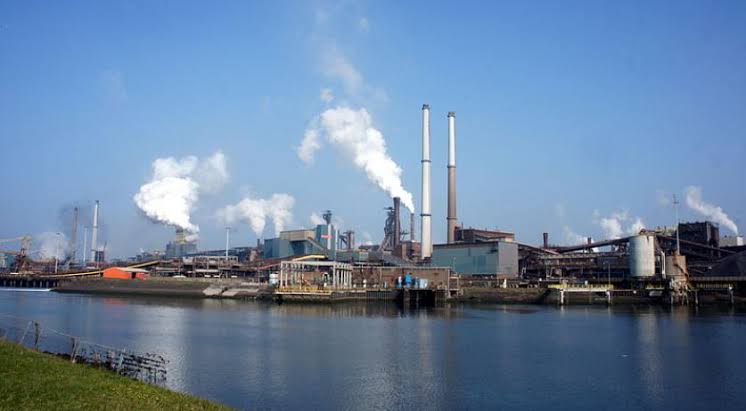

According to Dutch prosecutors, things went wrong almost six hundred times at the coke plants in IJmuiden. Phones were tapped, the company network was hacked. And once again, local residents are paying the bill.
Yesterday, 19 November 2026, I published an indictment on my website www.sempersimul.com against companies that still produce and distribute products containing PFAS. These life-threatening “forever chemicals” still end up in our environment every single day. In that piece I asked an uncomfortable question: could there be something fundamentally wrong with our social behaviour as human beings?
I did not expect the answer to come so quickly.
Are We Still Social Beings?
At every school and university it is taught with great conviction: humans are social beings. We work together, we care for one another, we take the community into account. Generations of students have written it down in their exams.
But anyone who follows the news sees something different, time and time again. Big money turns out to be far more attractive than social behaviour. Profit comes before health, shareholder value before public health, the quarterly figures before the future of our children.
Today brought another painful confirmation. A global corporation with a major site in the Netherlands is in the news because of an environmental scandal. I am talking about the company many still know as Corus, or even earlier as Hoogovens: Tata Steel in IJmuiden.
From Hoogovens to Corus to Tata Steel
A little background. Corus was created in 1999 through a merger between the Dutch Royal Hoogovens from IJmuiden and the British company British Steel. It became an Anglo-Dutch steel group with its main sites in IJmuiden and in Great Britain, including Port Talbot in Wales. The partnership was difficult from the start. In 2007 Corus was taken over by India’s Tata Steel, and since then the company in the Netherlands has been called Tata Steel Nederland.
A Year Full of Bad News
Over the past year, bad news about the steel giant has piled up:
- Job losses: Tata Steel is sticking to its plan to cut 1,200 jobs, about one fifth of its workforce. That is fewer than the 1,600 originally announced. According to management, the cuts mainly affect management layers.
- Criminal case: the Dutch Public Prosecution Service (Openbaar Ministerie, OM) summoned Tata Steel in July 2026.
- Contaminated soil: the company was ordered to clean up toxic soil.
- Coke and gas plants: Tata Steel is considering an accelerated closure of its polluting coke and gas plants.
- Government support: without billions in subsidies, those involved call the green transition “an impossible story”.
Years of Delay, Years of Pollution
That Tata Steel is one of the largest polluters in the Netherlands has been known for a very long time, far beyond our national borders too. Yet the Dutch government has given the company time again and again to reorganise, to become more sustainable and to reduce its pollution.
In my opinion, the company in its current form should have been closed long ago. But political and financial interests were apparently too great once again. Jobs, steel production, the economic position of the region: these are serious interests. But do they truly outweigh the health of thousands of local residents?
And today, 20 November 2026, a new criminal case against the company began.
It Is Only a Suspicion, and Yet…
The first hearing took place at the District Court in Amsterdam. The OM suspects Tata Steel IJmuiden of five criminal offences:
- Intentional environmental pollution at the two coke-oven gas plants, releasing substances of very high concern that may have endangered public health.
- Producing “green coke” (improperly heated coke) without a permit, almost six hundred times according to the OM, from early 2018 to July 2025. The OM itself speaks of a “large-scale character”.
- Inadequate maintenance: damaged ovens remained in use.
- Unreported incidents: three incidents in 2023 were not reported to the environmental regulator.
Phone Taps and a Hacked Company Network
What makes this investigation exceptional are the methods used by the authorities. Investigators tapped telephones and secretly entered Tata Steel’s computer network. In the Netherlands, such heavy investigative powers are normally only permitted when serious crimes are suspected.
That says a great deal about how seriously the authorities take this case. This is not about a forgotten form. According to the OM, this is about a pattern.
What Did Tata Steel’s Leadership Know?
The investigation began in May 2021 with a criminal complaint aimed specifically at the company’s executives. Yet at present only the company itself, Tata Steel IJmuiden B.V., is being prosecuted. No directors or managers stand trial. The OM expects to complete its file on the role of executives in the first quarter of 2027. It will then decide whether there are sufficient grounds to prosecute one or more individuals. Until then, the OM will make no statements on this.
So there is no established guilt. Tata Steel denies the accusations and says it will defend itself “with full conviction”. According to the company, green coke cannot be fully prevented for technical reasons. As with any suspect, the presumption of innocence applies.
Still, in my opinion, an uncomfortable question arises. How can something go wrong almost six hundred times in one of the most closely monitored plants in the Netherlands, without anyone at the top knowing about it? And if they did know, why did nobody intervene? Unfortunately, the answer will come in 2027 at the earliest.
The Bill for People and the Environment
And who ultimately pays the price? Not the shareholders in India. It is the people who live in the shadow of the chimneys.
Green coke releases PAHs (polycyclic aromatic hydrocarbons), some of which are carcinogenic, as well as fine particulate matter and heavy metals. As early as 2023, the Dutch National Institute for Public Health and the Environment (RIVM) established that Tata Steel’s total emissions are directly linked to disease. About 4 percent of new lung cancer cases per year in the surrounding area are attributed to the emissions, and about 3 percent of new asthma cases among children. Residents of Wijk aan Zee live on average around two and a half months shorter. Up to 80 percent of them suffer from dust, odour and noise.
How much of that damage was caused by the alleged incidents remains to be seen. But just imagine: you hang your laundry outside and bring it back in black. Your child coughs at night. And meanwhile, things go wrong six hundred times.
Are We Truly Social Beings?
From PFAS in our soil to fine particles above Wijk aan Zee, the pattern is always the same. First the money is made, then the damage is repaired, and the bill ends up with the citizen.
How many lungs, how many children and how many years of life is steel actually worth to us? Yet another fine example of how we and our planet are respected by the financially independent. Sorry, I mean the business world, of course!
Ton BakkerSources: Openbaar Ministerie (Dutch Public Prosecution Service), “Tata Steel suspected of five criminal offences relating to environmental pollution” (20 November 2026); Openbaar Ministerie, “OM summons Tata Steel” (8 July 2026); WNL, “Phones tapped and network hacked in investigation into Tata Steel” (20 November 2026); RIVM, “Direct relationship
between Tata Steel emissions and nuisance and risk of disease” (22 September 2023); RIVM, “RIVM study confirms Tata Steel site is main source of PAHs and metals in IJmond region”; NH Nieuws; DutchNews.
All suspicions mentioned originate from the Dutch Public Prosecution Service; until the court has ruled, the presumption of innocence applies to everyone involved. This article reflects the personal opinion of the author.
Leave a Reply